| Mentor | Serge |
|---|---|
| Organization | NixOS |
| Repo | github.com/sinanmohd/evanix |
Table of contents
Open Table of contents
Description
In evanix we explored making the scheduling of Nix builds more controllable. In particular, we look into implementing constraints such as –max-builds and –max-build-time, which ensure that build operations remain within manageable limits while maximizing throughput.
The scheduling problem here is framed as a mixed integer linear programming (MILP) problem. The input is a graph G=(V,E), where each vertex v represents a Nix package with a cost w(v) and a value p(v). Packages that are classified as transitive dependencies—those required solely for other packages—carry a value of 0. In contrast, packages that are requested for direct building are assigned a value of 1. This value structure reflects the prioritization of building requested packages over their dependencies.
Our approach aims to identify a set of vertices or packages following the precedence constraints that maximizes the value or the number of packages built with value 1. It is crucial that a vertex or package can only be selected if all of its dependencies are also selected. An edge in the graph represents a dependency, with the indegree of a vertex denoting the number of packages that depend on it and the outdegree representing the number of dependencies of the package.
We also developed a linear regression model to predict build times based on input derivations, enabling us to incorporate this information into our solver when it’s unavailable in Hydra. This predictive modeling greatly enhances our ability to estimate build durations for packages not built by Hydra, particularly those outside of Nixpkgs. By integrating these predictive insights with our MILP-based scheduling strategy, we aim to create a more robust nix build scheduler.
What was done
- Utilize mixed-integer programming to approximate the most optimal solution efficiently, using the HiGHS solver.
- Maximize the number of requested packages produced within a specified budget, with a maximum constraint of n builds.
- Maximize the number of requested packages produced within a specified budget, constrained by a maximum time limit of t.
- Utilize data from Hydra to estimate the build times for derivations.
- Develop a linear regression model to estimate build times for derivations when such data is unavailable in Hydra.
- Implement unit tests using Meson’s built-in testing framework, and integration tests utilizing the NixOS integration testing framework.
- Implement a pipelined architecture to initiate the building of derivations immediately following their evaluation.
Work for the future
- Enhance the linear regression model and conduct additional tests to validate its performance and accuracy.
- Integrate the linear regression model with evanix.
Milestones
SJF Scaffolding
The first solver implemented in evanix is the Greedy Shortest Job First (SJF), which is an approximate and heuristic-based solver. This solver selects the job with the least cost in each step to maximize throughput. The SJF solver can function perfectly if the requested jobs do not share dependencies. However, it falls apart when they do. An example is given in Figure 1.
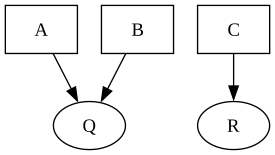
In the above DAG, if we’re given enough resources to build 3 packages, SJF would only be able to build 1 (C), instead of 2 if we were to choose A, B, Q. But this naive solver was crucial in scaffolding the rest of the evanix code, allowing us to subsequently develop a more sophisticated solver.
Conformity
While this solver is again an approximate and heuristic-based solver, it allowed us to refactor the evanix code to support multiple solvers. Being unfamiliar with HIGHS, we didn’t want to debug simultaneously the interaction with highs and the interaction with nix, so we decided to start with the simpler heuristic solver, so we can work on one thing at a time.
Here we use a concept called “conformity”. Conformity is a ratio between the number of direct feasible derivations sharing dependencies of our derivation and the total number of dependencies of our derivation. In each step we eliminate all packages that cost more resources than we can allocate, then we select the package with the highest conformity score. If conformity is the same for some packages then we select the package with the least cost.
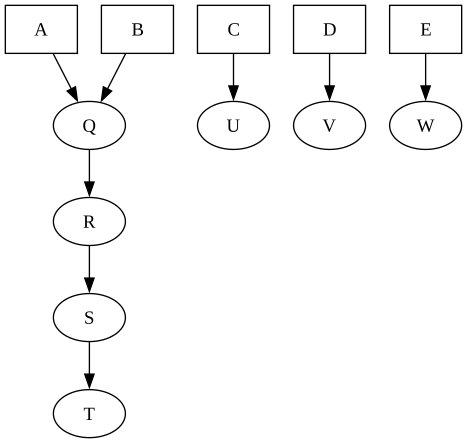
Higher the conformity, more the package will help other packages in our DAG, this gives packages in a cluster higher chance to be selected than isolated packages. This also has the advantage that our DAG will be quickly reduced to isolated packages. But being an approximate and heuristic-based solver, it has its own problems. In Figure 2 the algorithm will choose to build A & B if given enough resources to build 6 packages, being only able to build 2 packages instead of 3 if we were to choose D, C, & E.
Precedence Constrained Knapsack
The knapsack problem is a well-known integer programming problem that involves selecting items with given values and weights to maximize the total value without exceeding a weight capacity.
We’re dealing with a variant of the Knapsack problem, where additional constraints are imposed. These constraints, referred to as precedence constraints, introduce a new layer of complexity to the problem. It was not immediately obvious if all of the DAG constraints fit into the linear programming framework. It took us at least a week to figure out that the dependency characteristics of the DAG were essentially just inequality constraints, a crucial insight that Serge was the first to identify. This is a known combinatorial NP-hard problem.
We choose HiGHS as our mixed-integer linear programming (MILP) solver due to its established presence in numerous prominent open-source projects, such as SciPy. This choice is supported by HiGHS’ reputation for efficiency and robustness, which aligns well with our requirements.
Hydra Data
Now that we have a proper solver implemented in evanix, essentially covering the
--max-builds functionality, the next step was to implement --max-time. The
evanix code required very little refactoring for this. most of this phase was
spent addressing the data itself. We do not delve into how the estimation
affects systems with different resources. The first step was gaining access to
the historical data in Hydra. Huge thanks to the NixOS infrastructure team for
providing us with all the help we needed, especially
Hexa (Martin Weinelt). The PostgreSQL dump
contained about 30GB of data.
We built a recursive crawler to fetch dependencies for each derivation after
evaluating Nixpkgs. Even if the derivation path was available in the dump, the
.drv files themselves were not included. Thus, we established a simple mapping
from pname to build duration. However, for packages that are not in Nixpkgs,
we predict their build time using input derivations through a linear regression
model developed with SciPy. In this model, the independent
variables form an mxn matrix of pnames and each derivation. If an input
derivation required a particular pname, we set the value to 1 and 0 if it did
not. The dependent variables consist of a vector of build durations.
Tests
evanix uses nix-build and nix-eval-jobs. While the meson built-in testing
framework facilitates straightforward unit testing, evanix’s integration testing
process is complicated by its reliance on the actual Nix store, derivation (drv)
files, and substituters. This reliance on real components presents significant
hurles for integration testing. Our approach with Nix necessitates the
provisioning of all required real components within a sandboxed environment,
further complicating the integration testing landscape. To mitigate these
complexities, we employed a domain-specific language (DSL) based on Nix to
streamline the creation of test cases. Serge’s
expertise was instrumental in developing the evanix test infrastructure.
Acquiring new skills
During the GSoC period, I acquired a wide range of skills, including how to properly conduct integration tests. I gained insights into optimization problems, various types and solvers, as well as integer programming, linear programming, and mixed-integer linear programming. Additionally, I got a chance to implement many programming concepts that I had only read about in books, such as solving the producer-consumer problem using semaphores, which I had only read about in my university textbook two months prior. The best part was implementing everything in C, allowing me to experience these concepts from a lower-level perspective.
GSoC: The experience
Exploring different solutions with my mentor was the most exciting aspect of GSoC, and then seeing them come to life after implementation. If you’re aspiring to become a GSoC contributor, select an open-source project that interests you, use it, and identify areas for improvement, and start contributing.
Huge thanks to Serge for guiding me all the way through. your expertise, feedback, encouragement, and enthusiasm were extremely valuable to me. I learned lots of real-world skills, and most importantly, I had fun.